
- sophiaguo@sbmsolartech.com
- Home
- product
- Energy Storage System
- Solar Lights
- Other Solar Products
- Application
- Project
- About Us
- Blog
- Contact
Post time: 2026-07-07 10:15:55
Designing a reliable solar street lighting system is not just about choosing a “high wattage light.” In real engineering projects, pole height, LED wattage, and spacing distance must be designed together as one system.
A mismatch between these three factors is the main reason for: • Dark spots between poles • Over-bright or wasted energy systems • Premature battery drain • Failed government inspection or project rejection This guide explains how professionals actually design solar street lighting layouts.
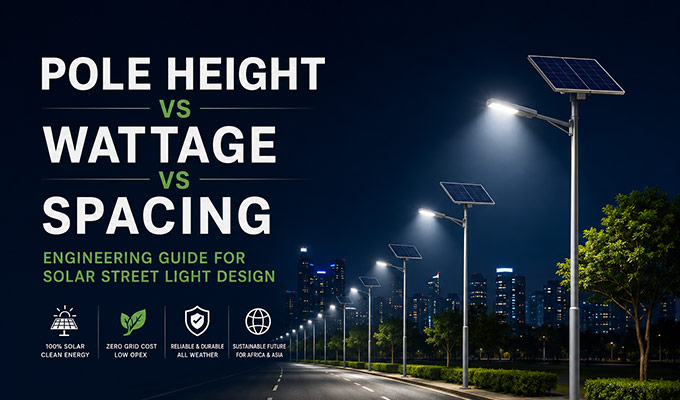
Street lighting design always follows a simple rule: Pole Height + Wattage + Spacing = Illumination Uniformity If one variable is wrong, the whole system fails visually or technically. • Higher pole → wider coverage, but lower ground lux • Higher wattage → more brightness, but more battery demand • Wider spacing → lower cost, but higher risk of dark zones
Pole height is the foundation of the design.
Typical ranges: Application | Pole Height Residential roads | 4–6m Urban streets | 6–8m Main roads | 8–10m Highways / industrial | 10–12m
Engineering logic: • Higher poles = wider light spread (larger coverage circle) • But also = lower illuminance intensity on the ground
Key mistake: Many projects use high wattage lights on low poles, which creates: • Glare • Uneven lighting • Energy waste
A common misunderstanding in solar lighting: Wattage does NOT directly equal brightness What wattage actually determines: • Energy consumption per hour • Battery size requirement • Solar panel size requirement
Example logic: • 30W LED system → small road, short spacing • 60W LED system → standard municipal road • 80–120W LED system → highways / wide roads
Important engineering fact: A poorly designed 100W light with weak battery performs worse than a well-designed 60W system.
Spacing determines whether lighting is continuous or broken.
Typical spacing guidelines: Pole Height | Recommended Spacing • 4–6m | 15–20m • 6–8m | 20–25m • 8–10m | 25–35m • 10–12m | 30–40m
What happens if spacing is wrong: • Too far → dark zones (safety risk) • Too close → wasted investment + over-lighting • Random spacing → uneven road appearance
Let’s compare two designs: Case A: Low-cost wrong design • Pole: 6m • Wattage: 100W • Spacing: 40m Result: • Bright under each pole • Dark gaps in between • Unsafe road sections
Case B: Proper engineered design • Pole: 6m • Wattage: 40–60W • Spacing: 20–25m Result: • Uniform lighting • No dark spots • Stable battery performance
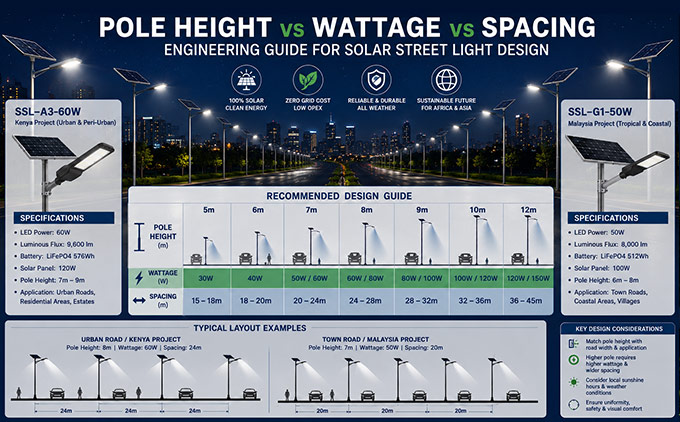
Most low-cost solar lighting projects fail not because of hardware—but because of poor system matching. Common mistakes: • Oversizing wattage to “look brighter” • Increasing spacing to reduce cost • Ignoring pole height constraints • No photometric simulation before installation These shortcuts always lead to: “Installed but not accepted” projects
If you don’t have full photometric simulation, use this simplified rule: • Pole height × 3 = safe spacing baseline • LED wattage should match road width, not pole height alone • Always prioritize uniformity over peak brightness
High-quality solar lighting projects (government / highway / EPC) always include: • Dialux or lighting simulation design • Pole spacing optimization • Lux level validation (lx map) • Battery autonomy calculation (3–5 rainy days backup) • Real lumen verification (not marketing lumens)
Solar street lighting is not a product choice—it is an engineering system. To achieve a successful project: Pole height defines coverage, wattage defines energy, spacing defines safety. When these three are properly matched, the system becomes: • More efficient • More stable • Longer lasting • Easier to approve in government projects
At Polybrite Solar, we don’t just supply solar street lights—we help engineers and contractors design full lighting systems based on real-world performance, not just specifications. If you are planning a road, highway, or municipal project, proper design at the beginning can significantly reduce cost and failure risk later.
Why Cheap Solar Street Lights Fail After 6 Months (And What Actually Works Long-Term) What is MPPT Controller in Solar Street Light? A Simple Engineering GuidePlease fill out the form below to start chatting with the next available agent.
Start Chat
Polybrite Solar Co., Ltd.
Tel/Whatsapp: +0086 13611691077
Email: sophiaguo@sbmsolartech.com
Sales Office Add: No. 1688 East Gaoke Road, Shanghai, China
Headquarter Add: Songqiao Industrial Park at northern suburbs of Yangzhou, Jiangsu Province, China
PolyBrite Site: International | Indonesian