
- sophiaguo@sbmsolartech.com
- Home
- product
- Energy Storage System
- Solar Lights
- Other Solar Products
- Application
- Project
- About Us
- Blog
- Contact
Post time: 2026-07-06 09:55:36
Solar street lights are everywhere today—from highways and rural roads to parking lots and residential communities. On paper, they look simple: solar panel + battery + LED light + controller. But in reality, many “cheap solar street lights” fail within 3–6 months of installation.
So why does this happen so often? And how can buyers avoid expensive mistakes?
Let’s break it down in a practical, engineering-focused way.
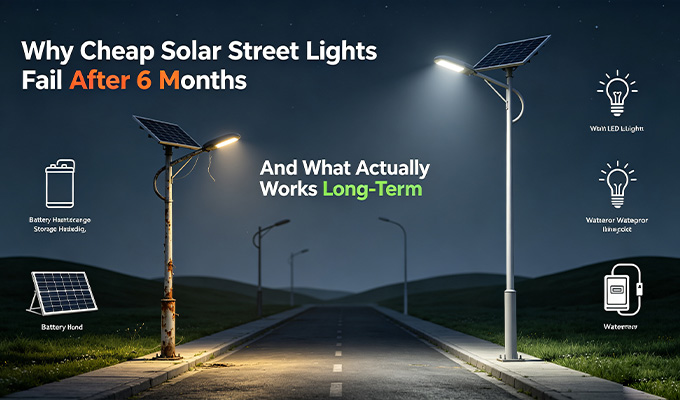
Most early failures are not caused by solar technology itself, but by aggressive cost reduction in critical components.
To win low-price bids, some suppliers reduce costs in areas that are not immediately visible: • Battery quality • LED chip grade • Controller protection systems • Waterproof sealing • Heat dissipation design The result: the product may work on day one—but cannot survive real outdoor conditions.
In most failed solar street lights, the battery is the first component to degrade. Cheap systems often use: • Low-grade lithium batteries • Recycled or inconsistent battery cells • No proper Battery Management System (BMS)
What happens in real use? • Capacity drops rapidly after repeated charging cycles • Runtime becomes shorter each night • Eventually, the light stops turning on completely In hot climates (Middle East, Africa, Southeast Asia), this problem becomes even worse because poor thermal protection accelerates aging.
Another common issue is specification inflation. Some low-cost products advertise: • “100W solar street light” • “20,000 lumens” • “All-night lighting guaranteed”
But in reality: • LED power is much lower than claimed • Efficiency is poor • Light output drops significantly after a few weeks This leads to a situation where: The light looks bright on installation day—but becomes dim or unusable shortly after.
Cheap solar lights often use lower-grade solar panels with: • Lower conversion efficiency • Poor low-light performance • Inconsistent quality control This causes a critical problem: • On sunny days → it works normally • On cloudy or rainy days → it undercharges • After a few cycles → battery never fully recovers Eventually, the system enters a “negative energy cycle” and stops functioning reliably.
Outdoor lighting must survive: • Heavy rain • Humidity • Dust storms • Coastal salt corrosion Low-cost solar lights often fail due to: • Weak sealing (IP rating not real or not tested) • Cheap rubber gaskets • Poor enclosure design Once water enters the system: • Controller short-circuits • Battery corrodes • LED driver fails And the failure is usually permanent.
Heat is one of the most underestimated factors in solar lighting failure. Cheap designs often: • Do not include proper heat sinks • Use plastic housings with poor thermal conductivity • Place battery and LED driver too close together In hot environments, internal temperature can exceed safe limits, causing: • Battery degradation • LED lumen depreciation • Controller instability This is why many lights fail quickly in regions like the Middle East or Africa.
Another hidden issue is inconsistent factory testing. Low-cost suppliers may skip: • Aging tests (24–72 hour burn-in) • Waterproof pressure testing • High-temperature cycling tests • Battery capacity verification Without testing, defective units are shipped directly to project sites.
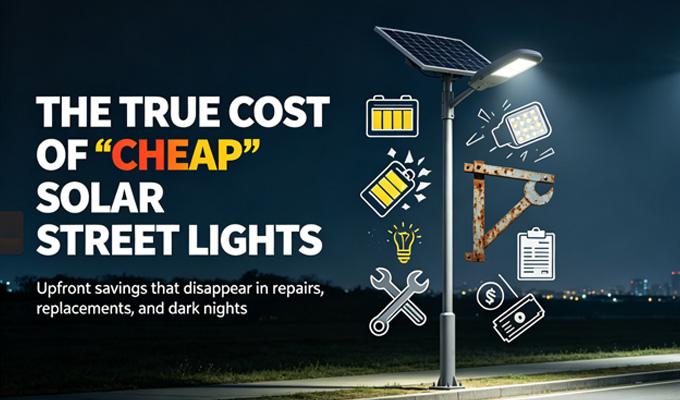
At first glance, a lower price seems attractive. But in real projects, failure leads to: • Re-installation labor costs • Transportation replacement costs • Project delays • Client complaints and reputational damage In many cases: Replacing cheap lights costs more than buying quality systems from the start.
A durable system is not just about price—it is about engineering integrity. A high-quality solar street light should include: • High-grade lithium battery with proper BMS • Efficient monocrystalline solar panel • Real waterproof rating (IP65–IP67 tested) • Aluminum housing with thermal management design • Smart controller (MPPT preferred) • Verified lumen output and photometric design • Strict aging and quality testing before shipment
Cheap solar street lights usually don’t fail because solar technology is unreliable. They fail because critical components are downgraded to reduce cost. For projects where reliability matters—roads, highways, public lighting, and government tenders—the real priority should be lifetime performance, not just initial price.
At Polybrite Solar, we focus on long-life performance, stable illumination, and engineered system reliability for demanding outdoor environments worldwide. If you are planning a project, choosing the right system at the beginning can save you years of maintenance cost and operational risk.
Why Solar Street Light Prices Vary So Much Between Suppliers? Pole Height vs Wattage vs Spacing: Engineering Guide for Solar Street Light DesignPlease fill out the form below to start chatting with the next available agent.
Start Chat
Polybrite Solar Co., Ltd.
Tel/Whatsapp: +0086 13611691077
Email: sophiaguo@sbmsolartech.com
Sales Office Add: No. 1688 East Gaoke Road, Shanghai, China
Headquarter Add: Songqiao Industrial Park at northern suburbs of Yangzhou, Jiangsu Province, China
PolyBrite Site: International | Indonesian