
- sophiaguo@sbmsolartech.com
- Home
- product
- Energy Storage System
- Solar Lights
- Other Solar Products
- Application
- Project
- About Us
- Blog
- Contact
Post time: 2026-07-03 15:43:57
If you compare solar street light quotations from different suppliers, you may notice something confusing: 👉 For what looks like the “same product,” prices can vary by 30% to even 100%+ This often leads buyers to ask: “Why is there such a big price difference?” The truth is: in solar street lighting, the visible product is only part of the story. The real cost comes from components, design, engineering choices, and quality standards that are not always obvious in a simple quotation. In this article, we break down the key reasons behind price differences so you can make smarter purchasing decisions.
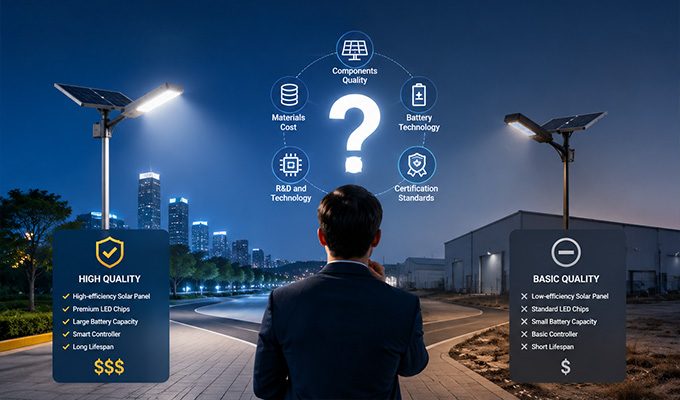
The lithium battery is usually the most expensive component in a solar street light. However, not all batteries are the same: Low-cost suppliers may use: • Recycled or Grade B cells • Lower cycle life (800–1200 cycles) • Smaller real capacity than labeled • Poor thermal protection High-quality suppliers use: • Grade A lithium cells (LiFePO4) • 2000–4000+ cycle life • Accurate capacity matching • Built-in BMS protection system 👉 This alone can create a 20%–40% price difference
Solar panels also vary significantly in cost and performance: Lower-cost panels: • Lower conversion efficiency (15%–17%) • Thin or low-grade silicon • Less stable output in cloudy weather Higher-quality panels: • 19%–23% high-efficiency • monocrystalline silicon • Better low-light performance • Longer lifespan (20–25 years) 👉 Even at same wattage label, real energy generation can be very different.
Many suppliers advertise “high wattage,” but what matters is real lumen output. Cheap systems may use: • Low-grade LED chips • Lower luminous efficacy (100–130 lm/W) • Faster light decay over time High-end systems use: • Bridgelux, Philips, Cree or equivalent chips • 160–220 lm/W efficiency • Better heat dissipation design 👉 Result: higher brightness with lower real power consumption.
The solar controller decides how efficiently energy is managed. Basic controllers: • PWM type • No intelligent dimming • Poor battery optimization Advanced controllers: • MPPT technology • Smart lighting control (timing + motion sensor) • Higher charging efficiency (10%–30% improvement) 👉 This directly affects runtime and rainy-day backup.
Some suppliers reduce cost by cutting structural quality: • Thin steel poles • Low galvanization coating • Poor wind resistance design • Weak mounting brackets High-quality systems use: • Hot-dip galvanized (HDG) poles • Anti-corrosion coating • Engineering-based wind load design 👉 Especially important for coastal, island, or typhoon areas.
One of the biggest hidden reasons for price variation is: Some suppliers: • Sell “standard copy models” • Do not calculate solar sizing per location • Use same configuration for all countries Professional manufacturers: • Design based on: • Local sunlight hours • Rainy season backup requirements • Installation height • Wattage requirement (road / highway / parking) 👉 Proper engineering design increases cost but ensures performance.
Price often reflects risk coverage: • Low-price suppliers: • 1-year limited warranty • No spare parts support • No engineering guidance Reliable suppliers: • 3–5 year warranty • Spare parts availability • Technical support for project design 👉 In real projects, after-sales support is often more valuable than initial price savings.
Export-ready products often require: • CE certification • RoHS compliance • IEC test reports • Local government tender compliance These add cost but are necessary for: • Government projects • EPC contracts • International bidding
Cheaper suppliers often reduce cost by skipping: • Aging tests before shipment • Full-system load testing • Waterproof testing (IP65/IP66 verification) • Reinforced export packaging Professional suppliers always include these steps to reduce failure risk during shipping and installation.
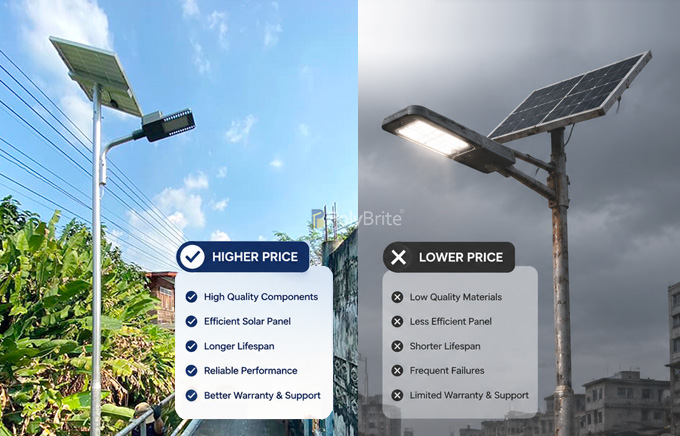
When solar street light prices vary, it is usually because: You are not comparing identical systems — you are comparing different levels of engineering, components, and reliability. A lower price may look attractive at first, but in real projects it can lead to: • Poor brightness • Short battery life • Frequent maintenance • Early system failure
When evaluating solar street light suppliers, don’t just ask: ❌ “What is the price?” Ask instead: ✔ “What battery is used?” ✔ “What is the real lumen output?” ✔ “Can it support my local sunlight conditions?” ✔ “What is the warranty and lifespan?”
At Polybrite Solar, we focus on engineered solar lighting solutions, not just products: • Project-based design (not one-size-fits-all) • High-efficiency lithium battery systems • Split and All-in-One solar street lights • Solutions for Africa, Middle East, Southeast Asia, Europe, and the Americas
All-in-One vs Split Solar Street Light: Which One is Better? Why Cheap Solar Street Lights Fail After 6 Months (And What Actually Works Long-Term)Please fill out the form below to start chatting with the next available agent.
Start Chat
Polybrite Solar Co., Ltd.
Tel/Whatsapp: +0086 13611691077
Email: sophiaguo@sbmsolartech.com
Sales Office Add: No. 1688 East Gaoke Road, Shanghai, China
Headquarter Add: Songqiao Industrial Park at northern suburbs of Yangzhou, Jiangsu Province, China
PolyBrite Site: International | Indonesian