
- sophiaguo@sbmsolartech.com
- Home
- product
- Energy Storage System
- Solar Lights
- Other Solar Products
- Application
- Project
- About Us
- Blog
- Contact
Post time: 2026-06-29 14:43:20
In rural areas of the Philippines such as barangay roads, coastal villages, and provincial highways, grid electricity is often unstable or not available.
For these environments, solar street lighting must be designed as a fully off-grid autonomous system, not just a lighting product.
The key challenge is not installation — it is system stability during 3–5 consecutive rainy days.
A reliable solar street light system in the Philippines should meet the following minimum standards:
☑ Lighting Duration · Minimum: 12 hours per night (sunset to sunrise) · Optional: motion sensor dimming for energy saving ☑ Backup Autonomy · 2–3 rainy days (standard) · 3–5 rainy days (recommended for typhoon regions) ☑ Environmental Protection · IP66 or higher waterproof rating · Anti-corrosion coating (especially coastal areas) · Wind resistance ≥ 120 km/h for typhoon zones
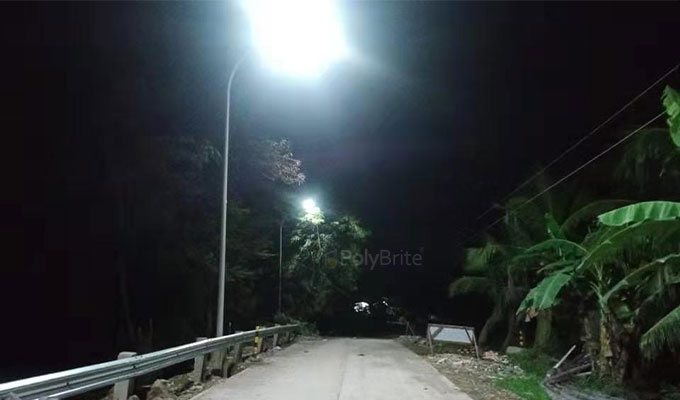
For typical barangay and rural road applications: · LED Power: 30–60W high-efficiency LED (≥180 lm/W) · Solar Panel: 80W–120W monocrystalline · Battery: LiFePO4 lithium battery (12.8V system preferred) · Controller: MPPT intelligent controller · Pole Height: 6–8 meters galvanized steel pole · Spacing: 25–40 meters depending on road width
In tropical countries like the Philippines, battery failure is the #1 reason for solar street light breakdown.
Recommended solution: · LiFePO4 battery with ≥2000 cycle life · Built-in BMS protection system · Temperature tolerance: -20°C to +65°C Avoid: · Cheap recycled batteries with unstable performance · Oversized LED with undersized battery (common supplier mistake)
Philippines projects must be designed for extreme weather conditions: · Continuous rain reduces solar charging efficiency by 40–60% · Therefore oversizing solar panel by at least 20–30% is recommended · Waterproof sealing must protect both battery and controller independently
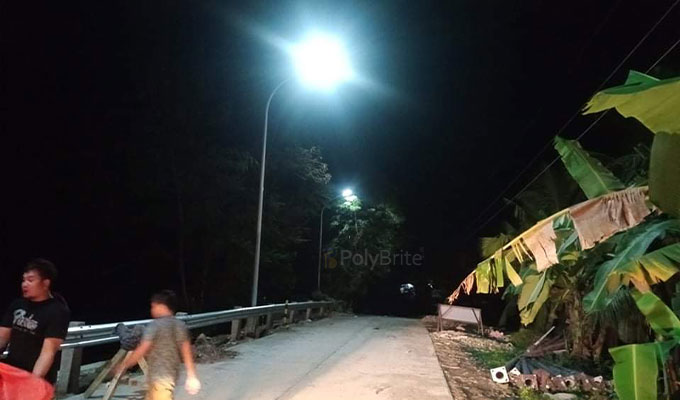
Many low-cost suppliers fail because: · They use “nominal wattage” LED chips (fake lumen output) · Battery capacity is not matched with lighting duration · No real MPPT controller (only PWM or fake labeling) · Poor thermal management causes battery degradation
For Philippine rural road projects, solar street lighting is not a simple product selection — it is a system engineering problem involving energy balance, climate adaptation, and storage design. Properly designed systems can achieve: · 8–10 years service life · Stable lighting even in typhoon season · Low maintenance cost for LGU projects
LiFePO4 Battery Lifespan in Solar Street Lights: What You Should Know in 2026 Solar Street Light Wattage vs Lumens: What Really Matters?Please fill out the form below to start chatting with the next available agent.
Start Chat
Polybrite Solar Co., Ltd.
Tel/Whatsapp: +0086 13611691077
Email: sophiaguo@sbmsolartech.com
Sales Office Add: No. 1688 East Gaoke Road, Shanghai, China
Headquarter Add: Songqiao Industrial Park at northern suburbs of Yangzhou, Jiangsu Province, China
PolyBrite Site: International | Indonesian