
- sophiaguo@sbmsolartech.com
- Home
- product
- Energy Storage System
- Solar Lights
- Other Solar Products
- Application
- Project
- About Us
- Blog
- Contact
Post time: 2026-06-30 15:01:14
When selecting solar street lights for road, highway, or project installations, many buyers still focus on one confusing question: “How many watts do I need?”
However, in real engineering applications, wattage alone does not determine lighting performance.
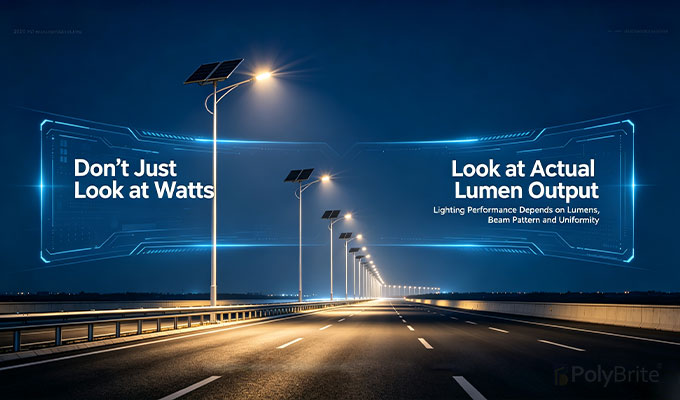
The more important metric is actually lumens (light output).
In this article, we will explain the real difference between wattage and lumens, and how to correctly evaluate solar street light performance for your project.
Wattage (W) refers to the power consumption of the LED system. In simple terms: · Higher wattage = higher energy consumption · Lower wattage = lower energy consumption However, wattage does NOT directly tell you how bright the light is.
For example: · A 100W low-efficiency LED may produce less light than a 60W high-efficiency LED. 👉 This is why wattage alone is misleading in solar lighting systems.
Lumens (lm) measure the actual brightness output of a light source. Unlike wattage, lumens tell you: · How much visible light is produced · How bright the road will appear at night Example: · 30W high-efficiency LED → 4,500–6,000 lm · 60W high-efficiency LED → 9,000–12,000 lm · 100W high-efficiency LED → 15,000–20,000 lm 👉 Lumens = real lighting performance
Many low-cost suppliers use “fake wattage marketing”, where: · LED chips are low efficiency · Driver current is limited · Actual brightness is much lower than claimed This leads to: · Dark road sections · Poor uniformity · Safety risks for vehicles and pedestrians 👉 In solar lighting projects, this is one of the most common failure reasons.
For professional solar street lighting systems, you should evaluate:
1. Luminous Efficacy (lm/W) This is the most important technical indicator. · Low quality: 100–120 lm/W · Standard: 130–150 lm/W · High efficiency: 160–210 lm/W Higher lm/W = more brightness with less power consumption.
2. Total Lumens Output This determines real road brightness and coverage area.
3. Battery Capacity Matching Even with high lumens, insufficient battery will cause: · early dimming · unstable lighting during rainy days
4. Solar Panel Oversizing For off-grid systems, solar panel must support: · full night lighting · 2–5 rainy days backup
Instead of asking: 👉 “How many watts do I need?” You should ask: 👉 “How many lumens do I need for my road?” Simple Engineering Reference: · Residential walkway: 2,000–4,000 lm · Village road: 4,000–8,000 lm · Main road: 8,000–15,000 lm · Highway / industrial road: 15,000–30,000 lm
For a 6–8 meter rural road installation: Recommended configuration: · 40W–60W high-efficiency LED · 9,000–12,000 lumens output · 80W–120W solar panel · 12.8V LiFePO4 battery system · 25–35 meters pole spacing This ensures: · full night lighting (10–12 hours) · stable performance in rainy seasons · long system lifespan (5–8 years)
Wattage is only an input power indicator, while lumens represent the actual lighting performance.
For solar street light projects, especially government or EPC installations, the correct evaluation method should always be: 👉 Focus on lumens, not wattage. A well-designed system balances: · Lumens output · Battery storage · Solar charging capacity · Environmental conditions
If you are planning a solar street lighting project, we can help you design a full system including: · lighting calculation · pole height selection · battery sizing · solar panel configuration 👉 Contact us for project quotation and technical support.
Solar Street Light Installation Design for Rural Roads in the Philippines All-in-One vs Split Solar Street Light: Which One is Better?Please fill out the form below to start chatting with the next available agent.
Start Chat
Polybrite Solar Co., Ltd.
Tel/Whatsapp: +0086 13611691077
Email: sophiaguo@sbmsolartech.com
Sales Office Add: No. 1688 East Gaoke Road, Shanghai, China
Headquarter Add: Songqiao Industrial Park at northern suburbs of Yangzhou, Jiangsu Province, China
PolyBrite Site: International | Indonesian