
- sophiaguo@sbmsolartech.com
- Home
- product
- Energy Storage System
- Solar Lights
- Other Solar Products
- Application
- Project
- About Us
- Blog
- Contact
Post time: 2026-07-16 10:38:10
One of the most common questions from buyers, contractors, and government project teams is:
How long do solar street lights actually last? The answer is not a simple number. It depends on system design, component quality, and environmental conditions.
In real engineering projects, a solar street light is not one product—it is a system made of multiple components with different lifespans. This guide breaks down the real-world lifespan of each part and what determines overall system durability.
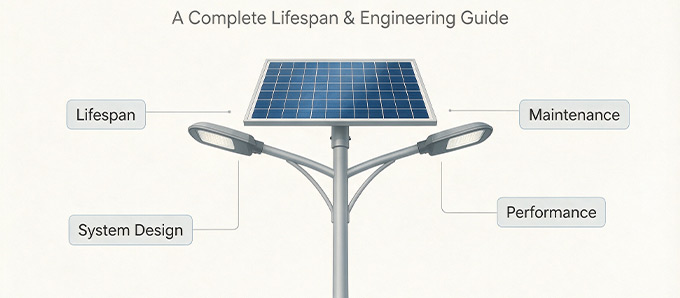
A high-quality solar street light typically lasts: 5 to 10 years (system lifespan) But each component has a different life cycle:
Component | Typical Lifespan LED light source | 50,000–100,000 hours (5–10 years) Lithium battery (LiFePO₄) | 3–8 years Solar panel | 20–25 years Controller (MPPT/PWM) | 3–7 years Pole structure | 15–25 years So the real question is not “how long the light lasts,” but: which part fails first, and how well the system is designed to delay failure.
In most real projects, the battery is the limiting factor. Typical performance: • Low-cost battery: 1–2 years • Standard lithium battery: 3–5 years • High-quality LiFePO₄ battery: 5–8 years Why batteries fail first: • Daily charge/discharge cycles • High temperature exposure • Over-discharge in cloudy seasons • Poor battery management systems (BMS) In most solar street lights, once the battery degrades, the whole system performance drops.
Solar panels are usually the most durable part of the system. Lifespan: • 20–25 years (with gradual efficiency decline) Degradation rate: • About 0.5%–1% per year (high-quality panels) What affects lifespan: • UV exposure • Dust accumulation • Humidity and salt corrosion • Manufacturing quality Even after 20 years, panels may still work at 70–80% efficiency.
LEDs are designed for long operation hours. Typical lifespan: • 50,000–100,000 hours But real-world factors reduce lifespan: • High temperature environments • Poor heat dissipation design • Over-driving current • Dust inside housing In hot climates, LED failure is often caused by heat, not LED quality itself.
The controller manages charging and discharging cycles. Typical lifespan: • 3–7 years depending on quality Failure reasons: • Water ingress • Overheating • Poor electronic components • Lightning or surge damage A weak controller can shorten the entire system life even if other components are good.
Poles usually last the longest if properly manufactured. Lifespan: • 15–25 years (HDG steel poles) Key factors: • Hot-dip galvanization quality • Anti-corrosion coating • Wind load design • Coastal salt exposure In coastal or island areas, corrosion protection becomes critical.
When solar lights fail very quickly, it is almost always due to: 1. Undersized battery → Cannot support full-night operation 2. Low-quality cells → Rapid capacity degradation 3. Poor waterproof design → Water damages electronics 4. Fake specifications → Wattage and lumen overstated 5. No real system engineering → Components not matched properly These failures are not “solar technology problems”—they are design and quality control problems.
The real lifespan of a solar street light depends on five key engineering factors: 1). Battery quality and thermal design 2). Proper system sizing (panel + battery + LED balance) 3). Heat management and housing design 4). Controller quality (MPPT stability) 5). Environmental conditions (heat, humidity, salt, dust) If all five are properly engineered: Solar street lights can operate reliably for many years with minimal maintenance.
Here is what typical well-designed systems achieve: • Year 1–3: Stable full performance • Year 3–5: Minor battery capacity decline • Year 5–8: Battery replacement may be required • Year 8–10+: LED and structure still functional (depending on design)
To maximize system life, professional projects focus on: • Using LiFePO₄ batteries instead of cheap lithium cells • Ensuring proper thermal separation of components • Oversizing solar panel for local climate conditions • Using MPPT controllers for stable charging • Applying IP65+ waterproof design standards • Conducting factory aging and testing before shipment
Solar street lights do not have a fixed lifespan because they are system-based products. The solar panel may last 25 years, while the battery may last 3–8 years. The system life depends on how well these components are designed and integrated. In real engineering applications, long-lasting solar lighting is not about choosing the cheapest product—it is about choosing the right system design.
At Polybrite Solar, we design solar lighting systems based on real environmental conditions, not just specifications on paper. Our focus is: • Long-life battery system design • Stable performance in harsh environments • Engineered component matching • Low-maintenance infrastructure solutions
Solar Street Lights for Highway Safety Projects: Engineering Guide for Reliable Large-Scale Road Lighting Top 10 Reasons Solar Street Lights Fail Early (And How to Avoid Them)Please fill out the form below to start chatting with the next available agent.
Start Chat
Polybrite Solar Co., Ltd.
Tel/Whatsapp: +0086 13611691077
Email: sophiaguo@sbmsolartech.com
Sales Office Add: No. 1688 East Gaoke Road, Shanghai, China
Headquarter Add: Songqiao Industrial Park at northern suburbs of Yangzhou, Jiangsu Province, China
PolyBrite Site: International | Indonesian