
- sophiaguo@sbmsolartech.com
- Home
- product
- Energy Storage System
- Solar Lights
- Other Solar Products
- Application
- Project
- About Us
- Blog
- Contact
Post time: 2026-07-15 10:53:24
Highways are among the most critical transportation infrastructures in any country. They connect cities, support logistics, and carry high-speed traffic 24/7. But at night, highway safety depends heavily on one factor:
Consistent, uniform, and reliable road lighting.
In many developing regions and remote areas, extending grid-powered lighting along highways is expensive and slow. That is why solar street lights are increasingly used in highway safety projects worldwide.
However, highway lighting is not a “standard solar street light application”—it is a high-level engineering system.
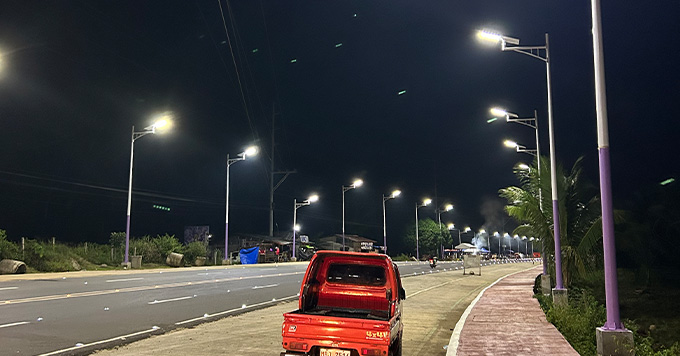
Highways require a completely different design approach compared to urban roads or village streets. Key differences: • Higher vehicle speed (60–120 km/h or more) • Longer visual distance requirement • Strict safety standards (accident prevention focus) • Wide road widths and multiple lanes • Continuous lighting consistency requirement On highways, lighting is not just visibility—it is safety control. A single dark section can significantly increase accident risk.
Traditionally, highways rely on grid-powered lighting. But solar lighting is now widely adopted because it offers: 1). No trenching along long road distances • Eliminates expensive underground cabling • Reduces construction disruption 2). Faster deployment • Ideal for large highway expansion projects • Can be installed in sections 3). Lower long-term operating cost • No electricity bills • Reduced maintenance infrastructure 4). Suitable for remote highways • Desert highways • Coastal highways • Mountain roads • Rural expressways Solar lighting is especially valuable where grid access is difficult or unstable.
Highway lighting must avoid: • Dark gaps between poles • Over-bright hotspots • Uneven road visibility • Flickering or unstable output The engineering goal is simple: Uniform lux distribution across the entire driving path This requires precise coordination between: • Pole height • Wattage • Spacing • Optical lens design • Battery autonomy
Highways typically require taller poles than standard roads. Typical range: • 10m – 12m (standard highway) • 12m – 15m (expressways / wide lanes) Why higher poles are used: • Wider light distribution area • Better lane coverage • Reduced glare for drivers • Improved spacing efficiency But: Higher pole = requires stronger LED output and better optical control.
Highway lighting requires higher luminous output than urban roads. Typical system ranges: • 80W – 120W → secondary highways / rural expressways • 120W – 200W → main highways • 200W+ → wide multi-lane expressways But wattage alone is not enough. What matters more is: • Real lumen output (not marketing wattage) • Optical lens efficiency • Uniform light distribution
Spacing determines whether a highway is safe or visually broken. General engineering guideline: Pole Height | Highway Spacing 10–12m | 30–40m 12–15m | 40–50m If spacing is too wide: • Dark zones appear • Drivers experience visual “blind spots” • Accident risk increases If spacing is too close: • Cost increases significantly • Energy waste occurs • Over-lighting causes glare Highway design is a balance between safety and efficiency.
Highway lighting must operate continuously throughout the night—even under poor weather conditions. Required battery design: • LiFePO₄ lithium battery (preferred) • 3–5 days autonomy backup • High-temperature resistance • Intelligent BMS protection
Why it matters: Highways cannot afford partial failure. Even one section failing can become a safety hazard.
Highway systems rely heavily on consistent energy harvesting. MPPT controllers: • Optimize solar energy capture throughout the day • Improve charging efficiency by up to 30% • Stabilize battery charging in cloudy conditions • Extend system lifespan For highway projects, MPPT is not optional—it is standard engineering practice.
One of the most overlooked factors in highway lighting is optics. Advanced systems use: • Asymmetric road lighting lenses • Wide beam angle distribution • Anti-glare design for drivers • Uniform lux mapping across lanes Without proper optics: Even high-wattage systems can create unsafe dark zones.
Many highway projects fail due to design errors, not product failure. Mistake 1: Using urban street light design → Results in insufficient coverage Mistake 2: Over-spacing poles to reduce cost → Creates dangerous dark gaps Mistake 3: Ignoring battery autonomy → Lights fail during rainy seasons Mistake 4: Using non-engineered lighting plans → No lux simulation or photometric design
A professional highway solar lighting system must have: • Engineering-based lighting design (lux simulation) • High-lumen efficiency LED systems • Proper pole height and spacing calculation • MPPT-based intelligent charging system • High-capacity LiFePO₄ battery backup • Wind-resistant HDG steel poles • Real waterproof and thermal-tested structure
Solar street lights are now a proven solution for highway safety projects—but only when properly engineered. The success of a highway lighting system depends on: Uniform lighting design + energy stability + structural reliability When these elements are correctly combined, solar lighting can deliver safe, stable, and cost-effective highway illumination even in remote and challenging environments.
At Polybrite Solar, we provide engineered solar street lighting systems designed specifically for highway and expressway safety projects worldwide. Our focus is on: • Real engineering design (not just product supply) • Long-term system stability • High-lumen uniform road lighting performance • Reliable operation in harsh outdoor environments
Solar Lighting for Rural Roads in Developing Countries: A Practical Engineering & Infrastructure Guide How Long Do Solar Street Lights Last? A Complete Lifespan & Engineering GuidePlease fill out the form below to start chatting with the next available agent.
Start Chat
Polybrite Solar Co., Ltd.
Tel/Whatsapp: +0086 13611691077
Email: sophiaguo@sbmsolartech.com
Sales Office Add: No. 1688 East Gaoke Road, Shanghai, China
Headquarter Add: Songqiao Industrial Park at northern suburbs of Yangzhou, Jiangsu Province, China
PolyBrite Site: International | Indonesian