
- sophiaguo@sbmsolartech.com
- Home
- product
- Energy Storage System
- Solar Lights
- Other Solar Products
- Application
- Project
- About Us
- Blog
- Contact
Post time: 2026-07-13 11:23:48
Across Africa, Southeast Asia, Latin America, and parts of the Pacific, millions of rural roads remain without reliable lighting. These roads are not just transportation routes—they connect villages, schools, clinics, markets, and ports. However, extending the electrical grid to these areas is often expensive, slow, and difficult to maintain.
That is why solar street lighting has become one of the most effective infrastructure solutions for rural development projects in developing countries.
But success depends heavily on proper system design—not just choosing any low-cost solar lamp.
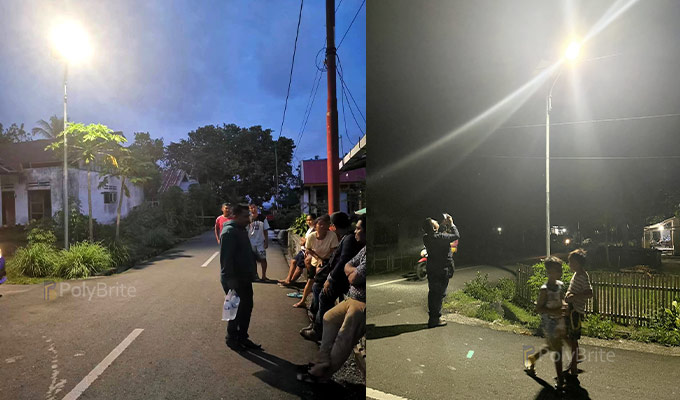
Rural roads in developing countries typically face: • No or unstable grid electricity • Poor road safety at night • High accident risk for pedestrians and vehicles • Limited public infrastructure funding • Long distances between settlements At night, many roads become: Completely dark, unsafe, and difficult to navigate Solar lighting directly improves: • Road safety • Community mobility • Local economic activity • Emergency response efficiency
Compared to grid-powered systems, solar street lights offer key advantages: 1). No trenching or cabling required • No underground wiring cost • No dependency on grid expansion projects 2). Fast deployment • Installation can be completed in hours, not weeks • Ideal for large-scale rural rollout projects 3). Low operating cost • No electricity bill • Minimal maintenance requirement 4). Scalable design • Can be deployed gradually across villages and districts For many governments and NGOs, solar lighting is the only financially viable solution for rural electrification of roads.
A major mistake in many projects is using urban lighting design standards in rural environments. Rural roads have different conditions: • Longer distances between poles • Lower traffic density • Limited maintenance access • Unstable weather conditions • Budget constraints per unit This means design must be optimized for: Cost efficiency + durability + minimum maintenance
Proper spacing design is critical for balancing cost and visibility. Typical engineering ranges: Road Type | Pole Height | Spacing Village roads | 4–6m | 15–20m Rural main roads | 6–8m | 20–25m Inter-village roads | 6–8m | 25–30m Key principle: Wider spacing reduces cost, but must not create dark safety zones. Poor spacing design is one of the most common causes of failed rural lighting projects.
Rural roads often face: • Multiple cloudy or rainy days • Limited maintenance access • Long repair response times Therefore, battery design is critical. Recommended configuration: • LiFePO₄ lithium battery • 3–5 days autonomy backup • Deep-cycle durability • Built-in BMS protection system Why it matters: If a system fails, repair may take weeks. So the system must survive extended low-sunlight periods independently.
Rural environments often include: • Dust • High humidity • Seasonal rainfall • Limited cleaning maintenance Recommended features: • High-efficiency monocrystalline panels • Anti-dust surface design (where possible) • Oversized capacity for energy buffer • Optimized tilt angle for local latitude The goal is consistent charging even under non-ideal conditions.
For rural infrastructure, reliability is more important than initial cost savings. MPPT controllers are preferred because they: • Maximize energy harvesting • Improve performance in cloudy weather • Stabilize battery charging cycles • Increase system efficiency Low-cost PWM controllers may reduce upfront cost but often lead to: Lower long-term reliability and reduced lighting consistency
Rural solar street lights must survive: • Rain and flooding conditions • Dust and wind exposure • Temperature variations • Limited maintenance cycles Key engineering requirements: • IP65+ waterproof rating • Anti-corrosion aluminum housing • Strong wind-resistant pole design (HDG steel) • UV-resistant materials
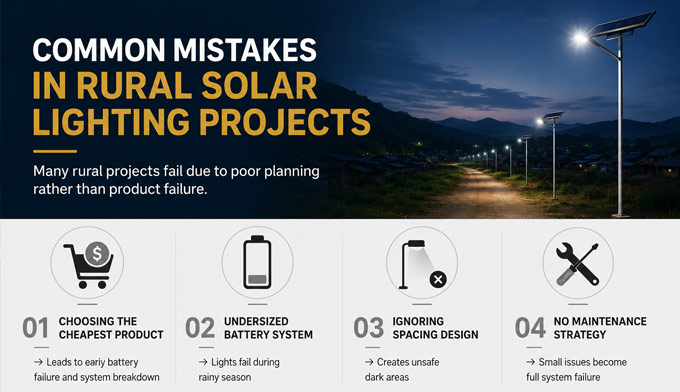
Many rural projects fail due to poor planning rather than product failure. Mistake 1: Choosing the cheapest product → Leads to early battery failure and system breakdown Mistake 2: Undersized battery system → Lights fail during rainy season Mistake 3: Ignoring spacing design → Creates unsafe dark areas Mistake 4: No maintenance strategy → Small issues become full system failure
When properly designed, solar lighting transforms rural infrastructure: • Safer nighttime travel for residents • Increased local business activity • Improved access to schools and clinics • Reduced crime risk in dark areas • Enhanced community development Lighting is not just infrastructure—it is social and economic enablement.
Solar street lighting is one of the most impactful infrastructure solutions for rural roads in developing countries. But success depends on one key factor: Engineering design, not just product selection. A properly designed system ensures long-term reliability, safety, and sustainability even in the most challenging environments.
At Polybrite Solar, we design and supply engineered solar street lighting systems specifically for rural electrification projects in developing countries. From village roads to national rural highway programs, we focus on: • Long-life system design • Stable performance in harsh environments • Low-maintenance infrastructure solutions
Solar Street Light Design for High Temperature Countries: Engineering Guide for Reliable Outdoor Lighting Solar Street Lights for Highway Safety Projects: Engineering Guide for Reliable Large-Scale Road LightingPlease fill out the form below to start chatting with the next available agent.
Start Chat
Polybrite Solar Co., Ltd.
Tel/Whatsapp: +0086 13611691077
Email: sophiaguo@sbmsolartech.com
Sales Office Add: No. 1688 East Gaoke Road, Shanghai, China
Headquarter Add: Songqiao Industrial Park at northern suburbs of Yangzhou, Jiangsu Province, China
PolyBrite Site: International | Indonesian