
- sophiaguo@sbmsolartech.com
- Home
- product
- Energy Storage System
- Solar Lights
- Other Solar Products
- Application
- Project
- About Us
- Blog
- Contact
Post time: 2026-07-10 11:44:49
In many regions around the world—such as the Middle East, North Africa, Sub-Saharan Africa, and parts of Southeast Asia—solar street lighting projects face one of the most difficult environmental challenges:
Extreme high temperature conditions, often exceeding 45°C–60°C in summer.
In these environments, many solar street lights fail not because of poor sunlight—but because of heat stress, battery degradation, and unstable system design.
This guide explains how to properly design solar street lights for high-temperature countries to ensure long-term reliability and stable performance.
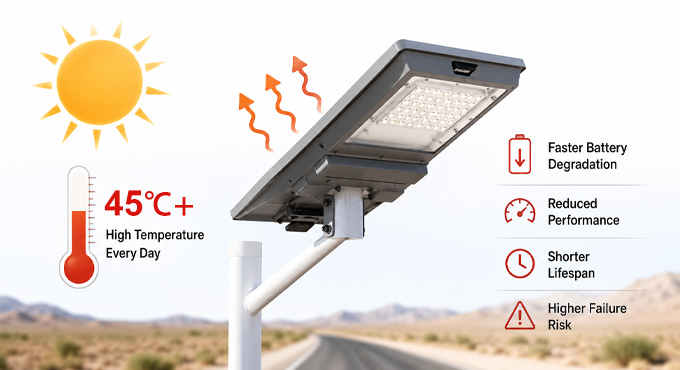
Most people think solar street lights fail due to rain or lack of sunlight. In reality, in hot regions, the main problem is: Heat accelerates component aging and reduces system lifespan dramatically. High temperature affects: • Battery chemical stability • LED efficiency and lumen depreciation • Controller reliability • Internal wiring insulation • Charging efficiency Even a high-quality system can fail early if thermal design is ignored.
The battery is the most heat-sensitive component in a solar street light. Common failure mode in hot countries: • Battery overheats during daytime charging • Internal chemical reaction accelerates • Capacity drops quickly • Night runtime becomes shorter over time Engineering requirements: A reliable high-temperature system must use: • LiFePO₄ (Lithium Iron Phosphate) batteries o More stable at high temperatures o Longer cycle life o Safer chemical structure • Thermal protection design o Battery separated from heat source (LED module) o Heat-resistant enclosure layout o Ventilation or heat dissipation structure • BMS (Battery Management System) o Temperature monitoring o Overheat protection o Charge/discharge control Without proper battery thermal protection, system failure is almost guaranteed in hot climates.
Heat management is often the biggest difference between low-cost and professional solar street lights. Poor design usually has: • Plastic housings • No heat dissipation structure • LED driver placed next to battery • No airflow design Professional design includes: • Die-cast aluminum housing • Integrated heat sinks • Separated battery chamber • Thermal conduction path design The goal is simple: Keep internal temperature stable even when external temperature exceeds 50°C.
LED chips are also sensitive to heat. What happens in extreme heat: • Lumen output decreases • Color temperature shifts • Lifespan shortens • Light degradation accelerates Key design improvements: • High-quality LED chips with low thermal resistance • Efficient driver design (constant current stability) • Proper heat sink contact surface • Lower driving current in extreme environments (derating strategy) In hot regions, a slightly lower wattage system often performs better long-term than oversized high-power lights.
High temperature does NOT always mean better solar performance. In fact: Solar panel efficiency decreases as temperature rises. Problems in hot countries: • Panel efficiency drops during peak heat hours • Dust accumulation reduces output further • Surface temperature can exceed 65°C Design recommendations: • High-efficiency monocrystalline panels • Proper tilt angle for airflow cooling • Anti-dust coating where applicable • Oversized panel capacity for thermal loss compensation
In high-temperature environments, system efficiency must be maximized. MPPT controllers help: • Optimize charging under heat stress conditions • Reduce energy loss during voltage fluctuation • Improve battery charging stability • Extend battery lifespan Compared to PWM systems: MPPT ensures more stable energy harvesting in harsh climates.
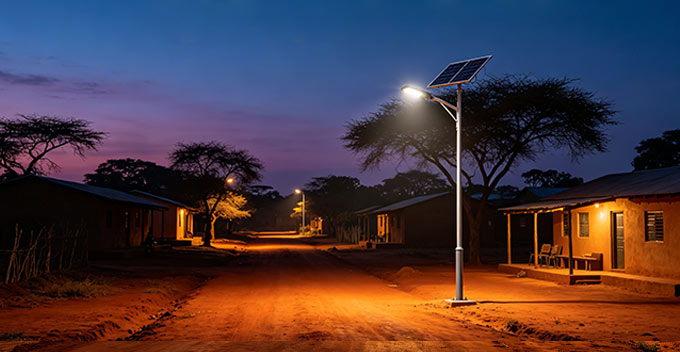
High temperature regions often come with: • Dust storms • Dry heat • Occasional heavy rain So protection is critical. Minimum requirements: • IP65 or higher enclosure rating • UV-resistant materials • Dust-proof sealing structure • Anti-aging rubber gaskets Heat + dust combination is especially dangerous for electronics.
In engineering design for hot climates, a key principle is: Do not design at maximum rated capacity—design with safety margin. This means: • Lower stress on battery (avoid full discharge cycles) • Avoid operating LED at maximum wattage • Oversize solar panel slightly for thermal loss • Provide extra battery autonomy (3–5 rainy/hot days backup)
Many failures come from design mistakes rather than product concept: Mistake 1: Using standard systems designed for temperate climates → Leads to overheating and early failure Mistake 2: Oversizing LED wattage without thermal consideration → Causes rapid lumen degradation Mistake 3: Ignoring battery heat exposure → Battery lifespan drops to less than 1 year Mistake 4: Poor enclosure material selection → UV and heat damage housing quickly
A properly designed high-temperature solar street light system can achieve: • Stable 8–12 hour night lighting • 3–5 years battery lifespan • Consistent lumen output • Low maintenance requirements • Reliable performance in 50°C+ environments
Designing solar street lights for high-temperature countries is not just about selecting higher-quality components. It is about: Thermal engineering, system balance, and long-term reliability design. When heat is properly managed, solar street lights become one of the most reliable and cost-effective lighting solutions for hot regions worldwide.
At Polybrite Solar, we specialize in engineered solar street lighting systems designed for extreme temperature environments, including the Middle East, Africa, and tropical regions. If you are planning a project, proper thermal system design can significantly improve lifetime performance and reduce maintenance costs.
Solar Street Lights for Islands and Off-Grid Areas: The Complete Practical Guide Solar Lighting for Rural Roads in Developing Countries: A Practical Engineering & Infrastructure GuidePlease fill out the form below to start chatting with the next available agent.
Start Chat
Polybrite Solar Co., Ltd.
Tel/Whatsapp: +0086 13611691077
Email: sophiaguo@sbmsolartech.com
Sales Office Add: No. 1688 East Gaoke Road, Shanghai, China
Headquarter Add: Songqiao Industrial Park at northern suburbs of Yangzhou, Jiangsu Province, China
PolyBrite Site: International | Indonesian