
- sophiaguo@sbmsolartech.com
- Home
- product
- Energy Storage System
- Solar Lights
- Other Solar Products
- Application
- Project
- About Us
- Blog
- Contact
Post time: 2026-07-08 12:01:42
When people compare solar street lights, they often focus on wattage, battery size, or solar panel area. But one of the most important components is usually ignored:
The MPPT controller — the “brain” of a solar street light system.
Without a good controller, even high-quality panels and batteries will not perform efficiently.
This article explains what MPPT is, how it works, and why it matters for real outdoor lighting projects.
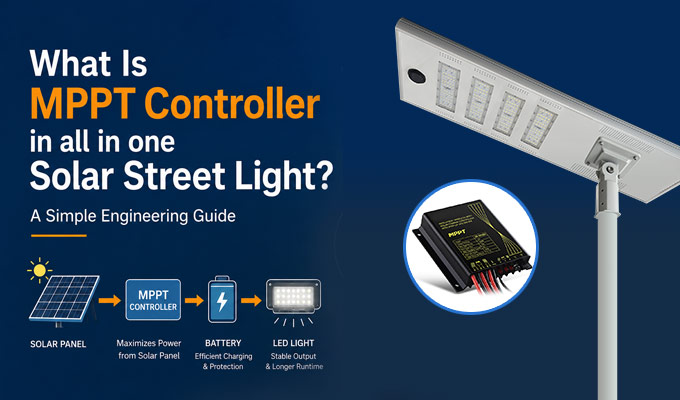
MPPT stands for Maximum Power Point Tracking.
An MPPT controller is a smart electronic device that: • Controls charging from the solar panel to the battery • Continuously finds the best operating voltage/current • Maximizes solar energy conversion efficiency
In simple terms: MPPT ensures your solar panel produces and delivers the maximum possible power under all weather conditions.
Solar panels do not always produce constant power. Their output changes depending on: • Sunlight intensity • Temperature • Cloud cover • Time of day
Without MPPT: • The system charges inefficiently • Energy is wasted
With MPPT: • The controller constantly adjusts voltage/current • It “tracks” the optimal power point • More energy is harvested and stored in the battery
Think of it like this: • PWM controller = fixed-speed charger • MPPT controller = intelligent automatic transmission car
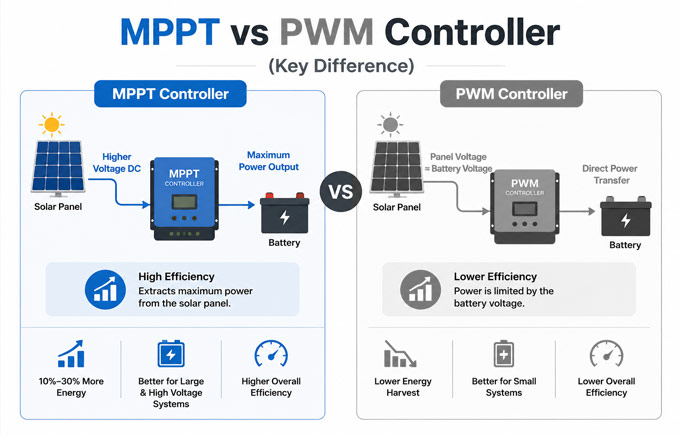
Most low-cost solar street lights still use PWM controllers, while better systems use MPPT.
Feature: PWM Controller | MPPT Controller Efficiency: Low–medium | High (up to +30% energy gain) Charging speed: Slower | Faster Performance in cloudy weather: Weak | Strong Temperature adaptation: Limited | Smart adjustment System cost: Cheaper | Higher but more efficient
Street lighting is not like small solar garden lights. It must work: • All night • In all seasons • In all weather conditions
MPPT becomes critical because it directly affects: 1). Battery charging reliability Better charging = deeper and more stable battery storage
2). Night lighting duration More stored energy = longer illumination time (8–12 hours or more)
3). Rainy/cloudy day performance MPPT can still extract energy even under low sunlight conditions
In many low-cost solar street lights: • Solar panel generates power, but not efficiently used • Battery never fully charges • Light duration decreases after a few months • System fails earlier than expected This is why some lights: Work well on day one, but fail after several rainy days.
MPPT controllers are especially important in regions with: • Frequent rain (Southeast Asia, Africa) • Dusty environments (Middle East) • High temperature variations • Unstable sunlight conditions In these environments, MPPT can significantly improve: • System stability • Night runtime consistency • Battery lifespan
A well-designed MPPT controller can improve energy harvesting by: • 10%–30% compared to PWM systems This means: • Same solar panel → more usable energy • Same battery → longer lighting hours • Same system → higher reliability
MPPT is not just about efficiency—it also protects the system: It helps: • Prevent overcharging • Optimize charging curves • Reduce battery stress • Extend battery life A solar street light is only as reliable as its battery health, and MPPT plays a key role in protecting it.
Many suppliers label any controller as “smart,” but in reality: • Not all “smart controllers” are MPPT • Some are just basic PWM with timers • Some only simulate MPPT behavior without real tracking That’s why real performance testing matters more than labels.
MPPT is highly recommended for: • Highway lighting projects • Government road lighting • Areas with unstable weather • Projects requiring 10–12 hour lighting autonomy • Export markets with strict performance expectations For small decorative garden lights, PWM may be enough. But for professional infrastructure projects, MPPT is the safer choice.
The MPPT controller is the hidden core of a solar street lighting system. It determines: • How efficiently solar energy is captured • How reliably the battery is charged • How long the light can run at night In real engineering projects, MPPT is not an upgrade — it is a necessity for stable performance.
At Polybrite Solar, we design systems with real MPPT-based controllers to ensure stable performance in demanding outdoor environments worldwide. If you are planning a project, choosing the right controller technology can significantly improve long-term reliability and reduce maintenance costs.
Pole Height vs Wattage vs Spacing: Engineering Guide for Solar Street Light Design Solar Street Lights for Islands and Off-Grid Areas: The Complete Practical GuidePlease fill out the form below to start chatting with the next available agent.
Start Chat
Polybrite Solar Co., Ltd.
Tel/Whatsapp: +0086 13611691077
Email: sophiaguo@sbmsolartech.com
Sales Office Add: No. 1688 East Gaoke Road, Shanghai, China
Headquarter Add: Songqiao Industrial Park at northern suburbs of Yangzhou, Jiangsu Province, China
PolyBrite Site: International | Indonesian